
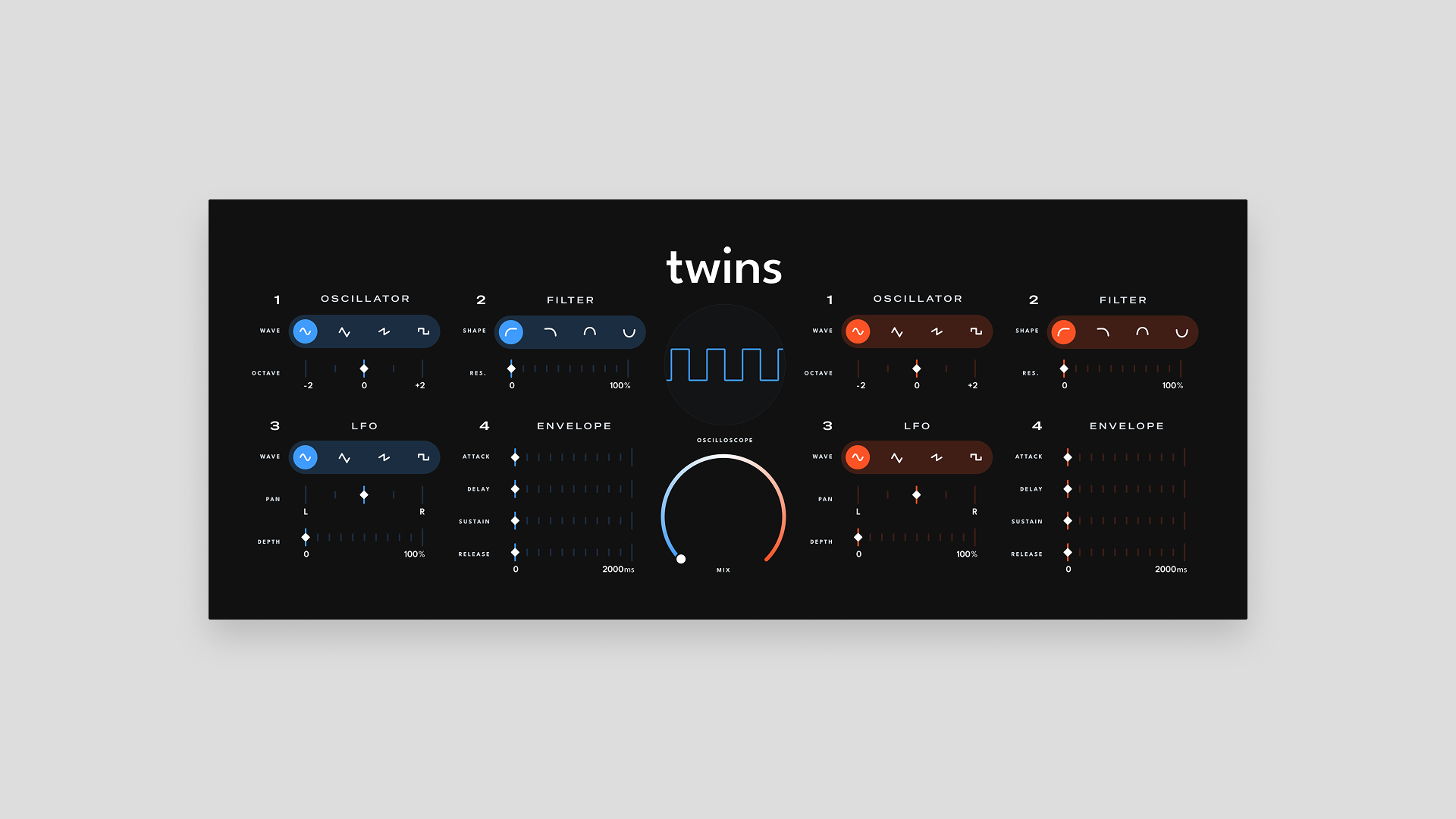
Twins is a dual-voice synthesizer designed to teach core synthesis concepts through explorative learning, sonic and visual feedback, constrained choices, and intuitive interactions that help build and reinforce mental models around sound design fundamentals.
Summary
Role: Product Designer
Timeline: January 2026
Tools: Figma, HISE, Pen & Paper
Status: Concept → High-fidelity prototype → Ready for development
Context
For people who are musically self-educated, formally educated, or some mix of both and want an intro to synth that’s no-nonsense and presents concepts in ways that are easy to understand.
Existing VSTs tend to prioritize either pedagogy or depth, leaving a gap between learning tools and instruments that advanced users reach for when they want simplicity.
The plugin supports learning through industry-standard product design practices that reinforce mental model formation.
Constraints
Determining what to remove in order to make the instrument basic enough for learning while remaining enjoyable for advanced users.
The LFO timing was locked down to a 1/2 beat and the entire VST syncs with the DAW clock in order to demonstrate a common LFO use without creating additional complexity.
Choices are limited and complexity is managed so users can focus on the basics: adding, subtracting, and refining waveforms.

Above: A diagram showing how interface controls map to their associated mental models—segmented controls for shaping, sliders for adjusting, and a single knob for mixing. By limiting and standardizing UI elements learners intuitively understand what each feature does, building strong mental models through consistent association.
Design story
The interface uses two distinct colors instead of symbols or graphics for each oscillator, playing on the idea of being able to mix the signal in the same way we might mix paint.
Visual feedback happens via an oscilloscope, using colors that align with the mixing knob, to teach cause and effect in a way that’s intuitive.
The noise feature, common in synthesizers, was removed because it created complexity that wasn’t important for teaching basics and might be at odds with the pad-focused and “locked LFO” aspects of the product.
The number of choices is constrained: limited modules, limited options, and limited possible combinations. This allows users to focus on synthesis fundamentals—sculpting sound.
The interface was optimized for learning by simplifying the layout to use just three main types of controls: button groups (segmented controls), sliders, and a single knob that pulls the whole concept of “mixing two sounds” together and provides visual feedback at the same time.
Simplicity in the UI was prioritized over matching traditional designs in hardware or plugins.
Outcomes
Desk research for inspiration, synth concept outlined, UI and interactive prototype created in Figma, and HISE exploration to make sure the product was technically viable.
The project began with a more complex concept, which was progressively reduced until it resolved into “Twins”.
A design system was built and a design library was created, using components and variables to quickly build the prototype and ensure scalability.
Reflection
The project was sketched on paper and multiple Figma breaks were taken, allowing time to think through how the instrument should work before committing to interface concepts.
Strong axioms established early in the process provided design constraints and drove innovation.
If designed again, the work could place greater emphasis on defined user demographics and device contexts. The current design prioritizes desktop DAW workflows but could also be explored from a mobile-first perspective.