
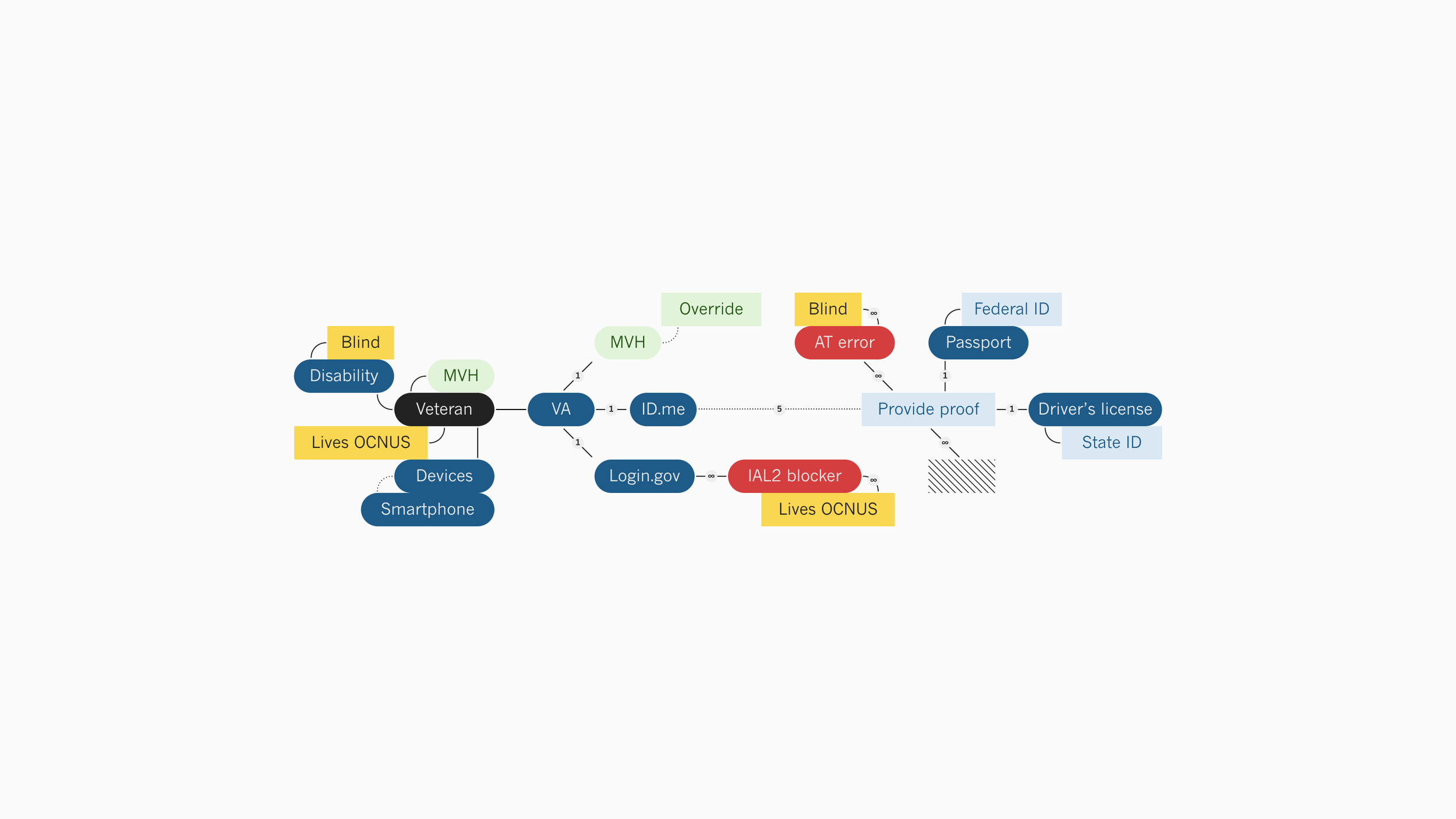
A modular persona and identity verification flow showing obstacles users might encounter while upgrading their login experience to meet IAL2 standards.
Summary
Organization: U.S. Department of Veterans Affairs
Product: VA Identity Services: VA.gov, Login.gov, ID.me
Role: Product Designer
Timeline: September 2024 to March 2025
Tools: Figma, Mural, Excel, PowerBI
Status: Concept → Shipped → In production → Completed
Recognition: FedID Award 2025, “Best Technical Advancement”
Context
The VA supports millions of veterans accessing critical benefits and services across healthcare, disability, and life events.
The product operates within a highly regulated federal environment, balancing accessibility, security and scale.
Many users rely on these systems during high-stress, vulnerable moments, and to complete vital tasks on a regular basis—clarity and reliability are essential.
The work focused on improving usability and accessibility, identifying critical edge cases, and aligning teams across federal, state, and private-sector partners within shared standards and constraints.
Constraints
Strict compliance requirements, including Section 508, WCAG, federal design standards, and NIST IAL2 identity assurance.
Legacy systems, technical debt, and fragmented service ownership.
Diverse user needs, including older users, users with disabilities, users with limited digital literacy, and users living outside of the continental US.
Cross-functional coordination across design, engineering, policy, and external stakeholders, including both internal and public-facing teams.
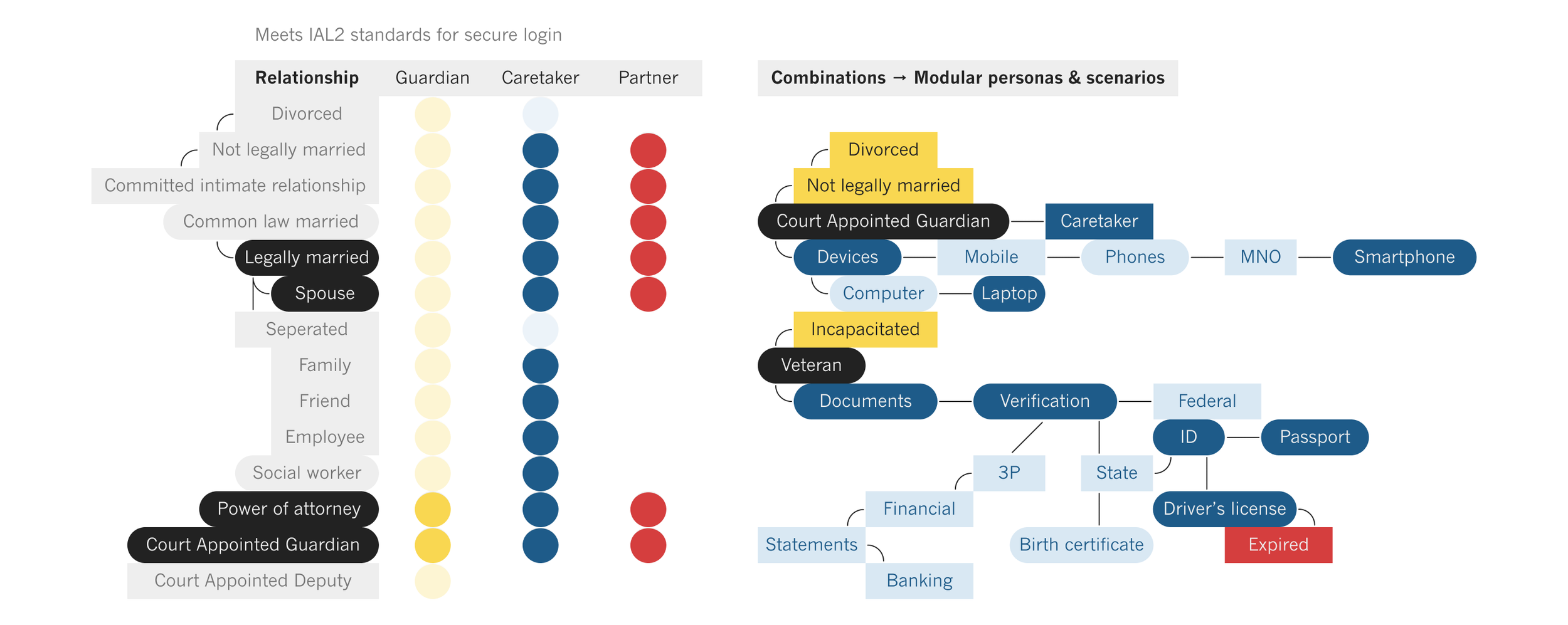
Left: A chart mapping first-degree relationships to veterans across legal and identity dimensions required for IAL2 compliance. Right: A modular persona highlighting the verification barriers these relationships introduce when attempting to act on a veteran’s behalf.
Design story
Early work focused on processing large volumes of qualitative data—sorting, visualizing, and presenting user barriers in ways stakeholders could clearly understand and act on.
Desk research included identifying and quantifying edge cases, alongside developing an ontology to standardize classification and reporting across teams.
Addressing multidimensional user needs required a modular approach to personas, allowing teams to isolate how individual attributes—and their combinations—directly impacted identity verification.
Designed a modular tracking system that scaled with data volume and could be used and maintained by teams with varying levels of data literacy.
Automated complex tasks, creating reports or combining data sources, so that internal stakeholders could focus on impact and decision-making rather than tooling overhead.
Outcomes
Programmatic reporting was requested and used for congressional briefings, directly influencing product, program, and policy decisions.
VA implemented an alternative verification pathway for users unable to meet IAL2 standards, ensuring no user lost access to benefits or health services.
The work was recognized with a FedID Award, acknowledging its impact at the federal level and its innovative approach to secure credential migration.
Reflection
Designing for government systems reinforced the importance of clarity, restraint, and accessibility at scale. The human impact was immediately clear.
Collaboration across disciplines was critical to navigating policy, technical, and user constraints—an interdisciplinary approach to understanding and building solutions helped align teams around objective outcomes.
The work demonstrated that strong design principles translate effectively even in highly regulated, complex, and evolving environments.